
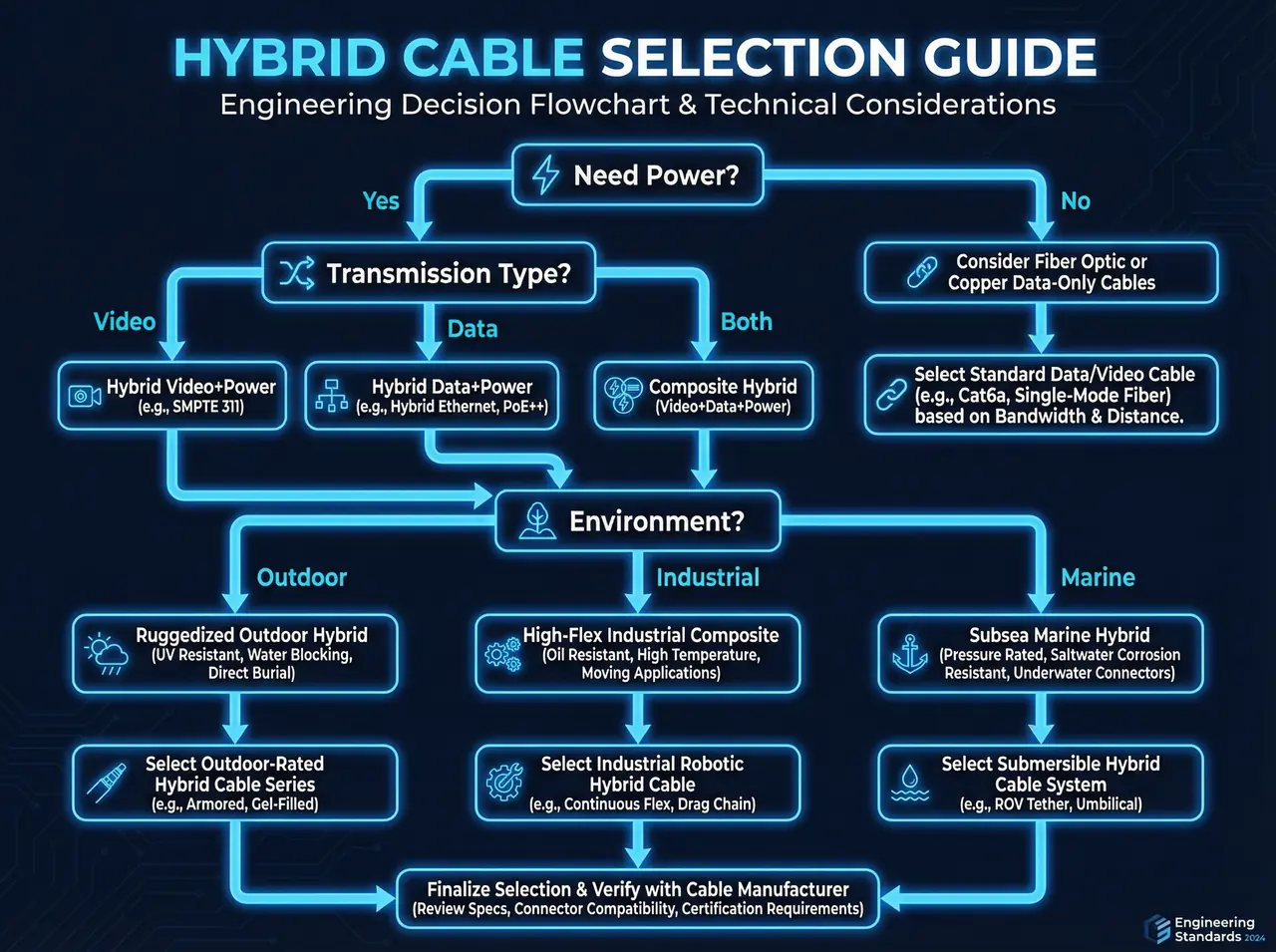
Hybrid Cable Selection Guide

Hybrid Cable
Selection Guide

A complete engineering decision framework — from signal type and environment assessment to cost analysis and certification requirements — to help you choose the right hybrid cable every time.

4-Step Selection Process

Follow this structured process to identify the optimal hybrid cable for your specific application and environment.

1
Define Signal Types
Identify what signals need to be transmitted: fiber optic, ethernet data, coaxial video, power, or control signals. The signal combination determines the cable family.
2
Assess Environment
Evaluate installation conditions: indoor/outdoor, temperature range, chemical exposure, mechanical stress, and fire safety requirements. Environment drives jacket and armor selection.
3
Calculate Distance & Power
Determine maximum cable run length and power requirements to select appropriate conductor sizes and fiber counts. Power loss calculations are critical for long runs.
4
Verify Standards
Confirm applicable standards: IEC, EN, UL, ATEX, marine, or railway certifications required for your installation. Certification requirements are non-negotiable in regulated industries.

Core Selection Decision Tree

Use this decision tree to systematically narrow down the right cable type for your project requirements.

1
Does the cable need to deliver power to end devices?
YES →
Hybrid Cable Required
Proceed to Step 2 to determine signal type
NO →
Standard Fiber Cable
Use conventional single-mode or multimode fiber
2
What is the primary signal transmission type?
VIDEO
Coax Hybrid Cable
RG59/RG6 coaxial + power for analog CCTV cameras
DATA
Ethernet or Fiber Hybrid
Cat6/Cat6A + power for short runs; Fiber + power for 2km+
MULTI-SIGNAL
Composite Hybrid Cable
Fiber + Ethernet + Power + Control in one cable
3
What is the installation environment?
OUTDOOR
Armored Hybrid Cable
Steel wire armor + UV-resistant PE jacket for direct burial or aerial
INDUSTRIAL
Shielded Hybrid Cable
Double shielding + LSZH jacket for EMI environments
MARINE / ATEX
Anti-corrosion Certified Cable
ATEX/IECEx + marine-grade materials for offshore and hazardous zones
4
What distance and power load are required?
≤ 100m
Ethernet + Power Hybrid
PoE++ (90W) capable, Cat6A data pairs
100m – 2km
Fiber + Power Hybrid
48VDC or 24VDC power + single/multimode fiber
> 2km
Backbone Fiber + Separate Power
High-voltage power conductors + single-mode fiber trunk

Signal Type → Cable Family

Each signal type maps to a specific hybrid cable family with distinct construction and performance characteristics.

📡
Coax Hybrid Cable
RG59 or RG6 coaxial conductor with integrated 18AWG power wires. Designed for analog CCTV cameras and video transmission with simultaneous power delivery.
Analog Video
🔌
Ethernet + Power Hybrid
Cat6/Cat6A data pairs with integrated power conductors. Supports PoE++ (90W) for high-power devices. Eliminates separate power runs for short-distance applications.
Data ≤ 100m
💡
Fiber + Power Hybrid
Single-mode or multimode fiber combined with 48VDC or 24VDC power conductors. Ideal for IP cameras, access points, and IoT devices over distances up to 2km.
Data / Video ≤ 2km
🔗
Multi-Signal Composite
Combines fiber, ethernet, power, and control signal conductors in one cable. For complex devices requiring multiple signal types simultaneously.
Multi-Signal
🛡️
Armored Hybrid Cable
Steel wire or tape armor over fiber+power construction. Provides mechanical protection for direct burial, aerial, and high-risk industrial installations.
Outdoor / Buried
LSZH Hybrid Cable
Low Smoke Zero Halogen jacket material for use in enclosed spaces, tunnels, and buildings where toxic smoke in a fire event is a critical safety concern.
Indoor / Tunnel

Environment → Cable Specification

Installation environment is the most critical factor in cable selection. Use this table to match your environment to the required cable specifications.

Environment Key Conditions Jacket Requirement Armor Certification
Indoor Office Controlled temp, low mechanical risk PVC or LSZH Not required IEC 60332
Outdoor Aerial UV exposure, wind load, temperature cycling UV-resistant PE Steel wire armor IP67 min
Direct Burial Soil pressure, moisture, rodents PE double jacket Steel tape + wire IP68
Industrial Factory EMI, chemicals, mechanical stress LSZH or PUR Braided shield IEC 61000-4
Railway / Tunnel Fire safety, vibration, long runs LSZH (mandatory) Steel wire armor EN 45545
Offshore / Marine Salt spray, humidity, explosion risk Marine-grade LSZH Stainless armor ATEX + IEC 60092
Hazardous Area (ATEX) Flammable gas / dust, explosion zones Flame-retardant LSZH Certified armor ATEX / IECEx (mandatory)

Critical Selection Mistakes to Avoid

These are the most common engineering errors that lead to system failures, cost overruns, and safety incidents in hybrid cable deployments.

Selecting by Price Alone
Low-cost cables often use undersized conductors, inferior shielding, or non-compliant jacket materials. The cost of a single field failure — including downtime, labor, and replacement — far exceeds the initial cable cost savings.
Ignoring Power Loss Calculations
Voltage drop over long cable runs can cause devices to malfunction or fail to power on. Always calculate conductor resistance and voltage drop for the full run length before specifying conductor cross-section.
Overlooking Connector Quality
The cable is only as reliable as its weakest connector. Field-terminated connectors with poor IP ratings or incorrect mating cycles are the most common cause of signal degradation and water ingress failures.
Underestimating Environment Severity
Specifying indoor-rated cable for outdoor or industrial environments leads to premature jacket degradation, insulation failure, and safety hazards. Always use the most demanding environment classification for the installation route.
Skipping Certification Verification
In regulated industries (railway, offshore, hazardous areas), using uncertified cable is a legal liability. Always verify that third-party test certificates are current and cover the specific cable construction being supplied.
Ignoring Minimum Bend Radius
Hybrid cables with fiber elements have strict minimum bend radius requirements. Violating these during installation causes permanent fiber damage that is not immediately visible but degrades signal performance over time.

How Hybrid Cable Reduces Total Cost

The true value of hybrid cable is not in the unit price — it is in the total cost of ownership across the full project lifecycle.

👷
Labor Cost Savings
Replace 3–5 separate cable runs with one hybrid cable. Installation labor is reduced by 40–60%. Fewer cable trays, conduits, and termination points mean faster project completion.
🔧
Maintenance Cost Savings
Fewer cables mean fewer failure points. Single-cable identification simplifies troubleshooting. Standardized connectors reduce spare parts inventory and field service time.
⚠️
Failure Cost Reduction
Integrated cables eliminate inter-cable connection points — the most common failure location. Fewer connectors mean fewer opportunities for water ingress, corrosion, and signal degradation.
📈
10-Year TCO Comparison
Analysis of 200+ infrastructure projects shows 30–50% lower total cost of ownership over a 10-year lifecycle when hybrid cables replace equivalent multi-cable installations.

Engineering Specification Checklist

Before placing a cable order, confirm all of the following specification points are defined and documented.

Signal types — fiber count, fiber type (SM/MM), data pairs, coax type, control conductors
Power requirements — voltage (12/24/48VDC), current per conductor, total power load
Maximum run length — longest single cable run in the installation
Installation method — conduit, direct burial, aerial, tray, or duct
Environment classification — indoor, outdoor, industrial, marine, or ATEX zone
Temperature range — operating and storage temperature extremes
Required certifications — IEC, EN, UL, ATEX, marine, railway standards
Connector type — IP rating, mating cycles, field-termination or pre-terminated
Quantity and reel lengths — total cable length, preferred reel sizes
Delivery timeline — standard vs. expedited, project installation schedule

Ready to Select the Right Cable?

Our engineering team provides customized cable selection recommendations within 24 hours. Browse our full product catalog or submit your project requirements directly.